
Introduction
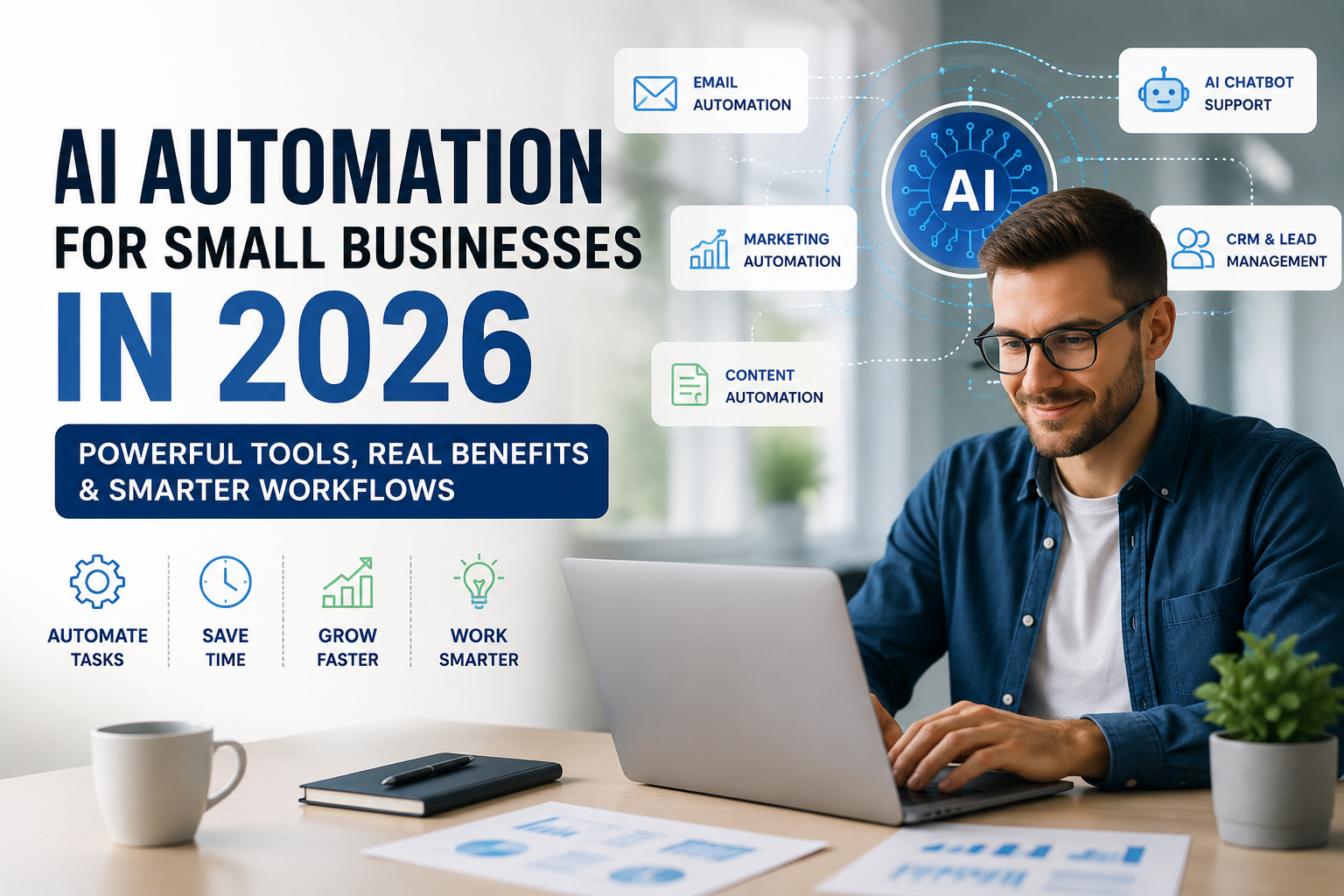
AI Automation for Small Businesses in 2026 is no longer just a technology trend. It has become a practical business strategy for companies that want to save time, reduce repetitive work, improve customer experience, and grow faster without hiring large teams.
Small businesses are now using AI-powered software to automate customer support, email marketing, lead generation, invoicing, content creation, analytics, scheduling, and even sales operations. What used to require a full team can now be handled through smart automation platforms and SaaS tools.
According to McKinsey & Company and Gartner, AI adoption among small and medium businesses continues to increase because automation improves operational efficiency and reduces long-term costs.
In this guide, you will learn:
- What AI automation means for small businesses
- Why businesses are adopting AI in 2026
- The best AI automation tools
- Real use cases and workflows
- Benefits and risks
- How to start using AI safely and effectively
Table of Contents
- What Is AI Automation?
- Why Small Businesses Are Using AI in 2026
- Main Benefits of AI Automation
- Best AI Automation Tools for Small Businesses
- Real AI Automation Use Cases
- AI Marketing Automation Strategies
- Common Mistakes to Avoid
- How to Choose the Right AI Tool
- Future of AI Automation
- Final Thoughts
What Is AI Automation?
AI automation refers to using artificial intelligence software to complete tasks automatically with minimal human effort.
Unlike traditional automation, AI systems can:
- analyze data,
- recognize patterns,
- generate content,
- answer customer questions,
- and improve over time.
For small businesses, this means faster operations and better productivity without increasing overhead costs.
Examples include:
- AI chatbots handling customer support
- Email automation tools sending campaigns automatically
- AI writing assistants generating blog content
- CRM systems tracking leads intelligently
- AI analytics dashboards predicting customer behavior
Why Small Businesses Are Using AI in 2026
The business environment has become highly competitive. Customers expect faster responses, personalized experiences, and better online service.
At the same time, many small businesses have limited budgets and smaller teams.
This is why AI automation tools are becoming essential.
Key Reasons Businesses Are Adopting AI
1. Lower Operational Costs
Automation reduces repetitive manual work. Businesses can handle more tasks without hiring additional employees.
2. Faster Customer Support
AI chatbots now answer common customer questions 24/7.
3. Better Marketing Performance
AI tools help businesses improve:
- email campaigns,
- SEO optimization,
- social media scheduling,
- and customer targeting.
4. Improved Productivity
Employees spend less time on repetitive tasks and more time on strategy and growth.
Main Benefits of AI Automation for Small Businesses in 2026
Increased Efficiency
AI tools complete tasks faster than manual workflows.
For example:
- invoice generation,
- appointment scheduling,
- email responses,
- and data entry
can all be automated.
Better Customer Experience
Customers prefer quick support and personalized communication.
AI-powered customer service tools can:
- reduce response times,
- improve satisfaction,
- and increase retention.
Smarter Marketing Campaigns
Modern AI marketing platforms analyze customer behavior and optimize campaigns automatically.
This helps businesses improve:
- open rates,
- click-through rates,
- and conversion rates.
Scalability
Small businesses can scale operations more easily using cloud-based SaaS automation tools.
Instead of hiring multiple departments, businesses can automate many workflows using software platforms.
Best AI Automation Tools for Small Businesses
Below are some popular SaaS tools that many businesses use for automation and productivity.
| Tool | Main Use | Best For |
|---|---|---|
| HubSpot | CRM & Marketing Automation | Lead management |
| Zapier | Workflow Automation | Connecting apps |
| Notion AI | Productivity & Writing | Team organization |
| Mailchimp | Email Marketing | Campaign automation |
| Canva | AI Design Tools | Content creation |
| Semrush | SEO & Marketing | Search optimization |
| Tidio | AI Chatbots | Customer support |
These tools are commonly used by startups, freelancers, agencies, and online businesses.
Real AI Automation Use Cases
1. AI Customer Support Automation
A small ecommerce store can use AI chatbots to answer:
- shipping questions,
- refund requests,
- order tracking,
- and FAQs.
This reduces support workload significantly.
2. AI Email Marketing
Businesses now automate:
- welcome emails,
- abandoned cart reminders,
- newsletters,
- and promotional campaigns.
AI tools also optimize sending times and audience segmentation.
3. AI Content Creation
Content marketing remains important for SEO.
AI writing assistants help businesses:
- generate article outlines,
- improve grammar,
- create social captions,
- and brainstorm ideas.
However, human editing is still essential for originality and trust.
4. Sales Funnel Automation
Sales automation platforms help businesses:
- qualify leads,
- track customer journeys,
- and automate follow-ups.
This improves conversion rates and customer retention.

AI Marketing Automation Strategies
Marketing automation is one of the strongest use cases for AI.
Businesses are using automation to manage:
- email campaigns,
- SEO workflows,
- customer segmentation,
- social media scheduling,
- and analytics reporting.
Example Workflow
A business owner can create an automated system where:
- A visitor downloads a free guide
- The CRM captures the lead
- AI segments the customer
- Automated emails are triggered
- Analytics track conversion performance
This entire process can happen automatically.
Common Mistakes to Avoid
Over-Automating Everything
Not every task should be automated.
Businesses still need human oversight for:
- customer relationships,
- brand voice,
- and strategic decisions.
Using Too Many Tools
Many businesses subscribe to too many SaaS platforms unnecessarily.
Start with a few essential tools first.
Ignoring Data Privacy
Businesses should use trusted software providers and follow data protection best practices.
Useful reference:
Google Search Central SEO Guidelines
How to Choose the Right AI Automation Tool
Before choosing software, businesses should evaluate:
Business Goals
Ask:
- What problem are you trying to solve?
- Which workflow consumes the most time?
Integration Support
Choose tools that connect with existing platforms.
For example:
- CRM systems,
- email tools,
- ecommerce stores,
- and analytics dashboards.
Ease of Use
A complicated platform can reduce productivity.
Look for tools with:
- simple dashboards,
- tutorials,
- and customer support.
Pricing and Scalability
Many SaaS tools offer free plans for small businesses.
Choose platforms that can scale as your business grows.
Future of AI Automation for Small Businesses
AI automation will continue evolving rapidly beyond 2026.
Future trends may include:
- smarter AI assistants,
- predictive analytics,
- voice automation,
- AI-powered ecommerce,
- and personalized customer experiences.
Businesses that learn automation early may gain a competitive advantage.
However, successful companies will combine AI efficiency with human creativity and trust.
Expert Insight
One of the biggest misconceptions about AI automation is that it replaces businesses owners or employees completely.
In reality, the most successful businesses use AI as a support system rather than a replacement for human expertise.
The companies seeing the best results are using automation strategically:
- improving workflows,
- increasing efficiency,
- and enhancing customer experience,
while still maintaining strong human decision-making.
That balance is what creates sustainable growth.
Final Thoughts
AI Automation for Small Businesses in 2026 is becoming an important part of modern business operations.
From marketing and customer support to sales and productivity, automation tools help businesses operate more efficiently and compete in digital markets.
The key is choosing reliable tools, focusing on real business needs, and implementing automation gradually.
Small businesses that adapt early may benefit from:
- lower operational costs,
- stronger marketing performance,
- better customer engagement,
- and long-term scalability.
Call To Action
Are you planning to use AI automation tools for your business in 2026?
Start by testing one workflow first — such as email marketing, customer support, or content planning — and measure the results before expanding your automation strategy.
