

The distinction between “automation” and “AI agents” matters more than it sounds. Traditional automation follows fixed rules — if this happens, do that. An AI agent works toward a goal, adapting its actions as conditions change, without someone manually updating the rules every time something shifts. That difference is why agents are increasingly handling entire workflows rather than single repetitive steps.
What an AI Agent Actually Is
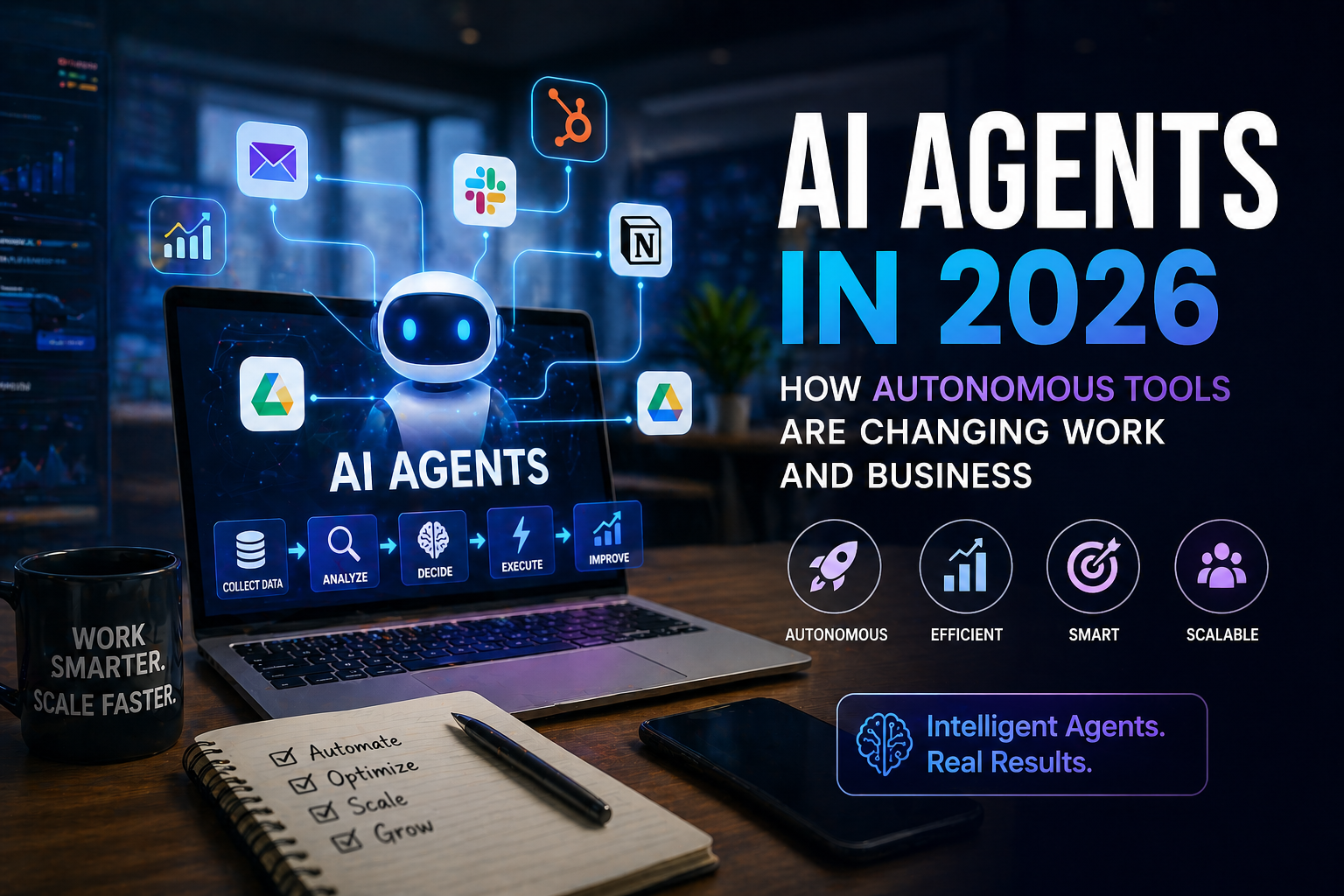
An AI agent operates on a loop: it collects data, analyzes the situation against a defined goal, decides on an action, executes it, and adjusts based on the outcome. In a marketing context, that might mean tracking user behavior, adjusting audience segments, and refining messaging without someone manually reviewing each campaign daily. The agent isn’t just executing a fixed script — it’s making judgment calls within boundaries a human set up in advance.
Why This Is Replacing Simpler Automation
Rule-based automation breaks down as soon as a situation falls outside what it was explicitly programmed to handle — it can’t adapt to a scenario nobody anticipated when writing the rules. Agents are more resilient to this because they’re working toward an outcome rather than following a fixed script, which lets them handle a wider range of situations without constant manual reconfiguration.
Tools Worth Knowing
| Tool | Best For | Trade-off |
|---|---|---|
| Zapier | Beginners connecting apps and simple workflows | Limited true autonomy — closer to rule-based automation |
| Make | More complex, multi-step automated workflows | Real learning curve to build well |
| AutoGPT | Advanced users experimenting with autonomous task execution | Requires technical setup and careful oversight |
| AgentGPT | Non-technical users wanting a simple, browser-based entry point | Less control than more technical alternatives |
This is a fast-moving space, and the specific tools available change frequently — the practical skill worth building is understanding what an agent-based workflow can and can’t reliably handle, more than mastering any one specific product.
Where Businesses Are Actually Using This
Common applications include marketing campaigns that adjust targeting and messaging based on real-time engagement, customer support that triages and resolves routine questions before escalating anything genuinely complex to a person, and operations workflows — inventory checks, scheduling, basic reporting — that used to require someone checking in manually on a fixed schedule.
The Real Risk: Autonomy Without Oversight
The appeal of an AI agent is that it acts without constant supervision, but that’s also the risk — an agent making decisions based on a flawed goal or bad data can compound that mistake at scale before anyone notices. Reviewing agent decisions periodically, especially early on, and setting clear boundaries on what an agent is and isn’t allowed to do autonomously, matters more than the specific tool you choose.
Getting Started
- Start with a single, narrow workflow rather than trying to automate an entire operation at once.
- Choose a tool that matches your current technical comfort — Zapier or AgentGPT for a simple starting point, Make or AutoGPT once you need more control.
- Monitor closely for the first few weeks before trusting an agent to run with minimal oversight.
The Bottom Line
AI agents represent a genuine shift from automating individual steps to automating outcomes, and that shift is already showing up in how marketing, support, and operations teams work. The businesses getting real value aren’t necessarily using the most advanced agent available — they’re the ones who set clear goals and boundaries and reviewed results carefully before scaling up. For how this connects to marketing specifically, see our guide to AI marketing automation.
Author
Written by Alibashi Abdirahman Olad, founder and publisher of BashiOnline.
Disclaimer
This content is for educational purposes only. AI agent tools and capabilities are evolving quickly; verify current features before adopting any specific platform.
[…] The Powerful Rise of AI Agents in 2026: How Autonomous Tools Are Changing Work and Business […]