

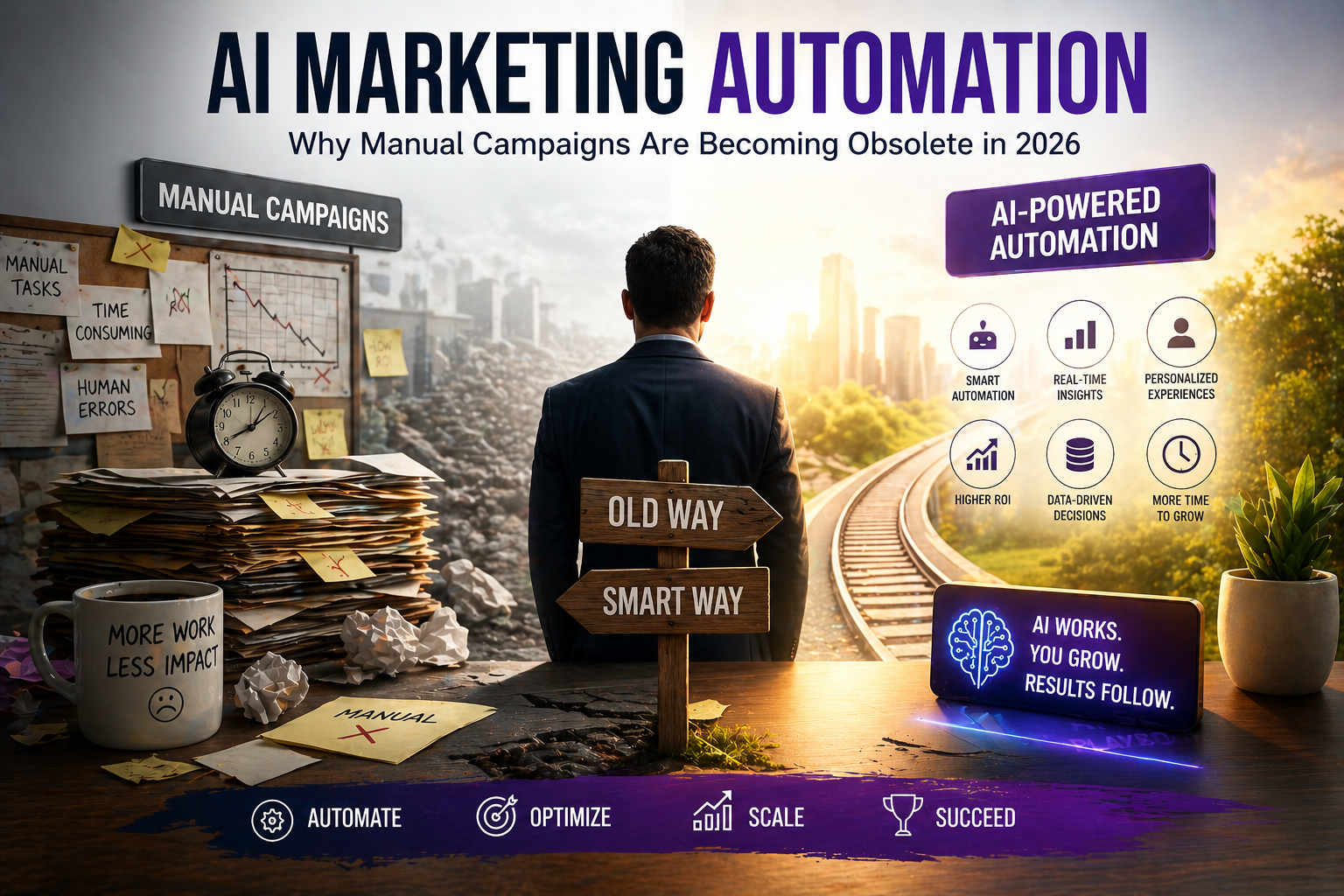
Running marketing manually — segmenting lists by hand, sending the same email to everyone, guessing at timing — has become a genuine competitive disadvantage. AI-driven marketing automation doesn’t replace strategy, but it removes most of the repetitive execution work and reacts to customer behavior faster than a person checking a dashboard once a week ever could. This guide covers what AI marketing automation actually does, the tools worth knowing, and how to choose between them.
What AI Marketing Automation Actually Does
Unlike basic automation — a fixed email sequence that fires the same way for everyone — AI-driven systems adjust based on real behavior: predicting which customers are likely to churn, dynamically segmenting audiences instead of relying on static lists, and continuously refining send times and content based on what’s actually working rather than a fixed schedule set once and forgotten.
Why Manual Campaigns Increasingly Fall Behind
Manual marketing has three structural limits that don’t scale: it’s slow to adjust when something isn’t working, it defaults to generic messaging because true personalization at scale is impractical by hand, and it struggles to meaningfully analyze data beyond a handful of top-line metrics. None of this means a person’s judgment becomes unnecessary — it means that judgment is better spent on strategy and creative direction than on manually building the fortieth audience segment.
Tools Worth Knowing
| Tool | Best For | Trade-off |
|---|---|---|
| HubSpot | Small to mid-sized businesses wanting an all-in-one platform | Advanced features sit behind higher-priced tiers |
| Mailchimp | Email-focused campaigns, simple setup | Less depth than dedicated automation platforms |
| ActiveCampaign | Behavior-based automation workflows | Real learning curve to configure well |
| Marketo (Adobe) | Large-scale, enterprise marketing operations | Higher cost and complexity, overkill for small teams |
Choosing Based on Where You Actually Are
Early-stage businesses generally benefit most from simplicity — Mailchimp or HubSpot’s entry tier cover the basics without a steep learning curve. As a marketing operation matures, ActiveCampaign’s behavior-based workflows offer more sophistication without enterprise-level cost. Marketo makes sense mainly for larger operations already managing complex, multi-channel campaigns at scale. Starting with one platform and expanding only once you’ve outgrown it tends to work better than adopting an enterprise tool prematurely.
What Changes When You Actually Implement This
Businesses that move from manual to AI-assisted marketing typically see the same pattern: messaging becomes more relevant because it’s based on actual behavior rather than broad assumptions, tracking becomes more consistent because the platform handles it automatically, and the team spends less time on repetitive execution and more on strategy. The size of the improvement depends heavily on how thoughtfully the automation is set up — a poorly configured automated campaign performs worse than a well-executed manual one.
Getting Started Without Overcomplicating It
- Automate one workflow first — a welcome sequence or cart abandonment flow — rather than rebuilding your entire marketing stack at once.
- Use existing customer data to inform segmentation rather than starting from generic demographic guesses.
- Review performance regularly and adjust — automation reduces manual work, but it still needs oversight to stay effective.
The Bottom Line
AI marketing automation isn’t about replacing marketers — it’s about removing the repetitive execution work that keeps them from spending time on strategy and creative direction. The businesses getting real value from it aren’t necessarily using the most advanced tool; they’re using a tool that matches their actual scale, configured thoughtfully rather than left on autopilot. For how this fits into a broader marketing strategy, see our online marketing techniques guide.
Author
Written by Alibashi Abdirahman Olad, founder and publisher of BashiOnline.
Disclaimer
This content is for educational purposes only. Tool features and pricing change over time; verify current details before choosing a platform.
[…] The Powerful Rise of AI Marketing Automation: Why Manual Campaigns Are Becoming Obsolete in 2026 […]
[…] The Powerful Rise of AI Marketing Automation: Why Manual Campaigns Are Becoming Obsolete in 2026 […]