

Introduction
A decade ago, a company generating eight figures in annual revenue almost certainly had a payroll to match — a marketing team, a support desk, a handful of engineers, maybe an office lease. In 2026, that assumption no longer holds. Some of the fastest-growing, most profitable businesses in the country have exactly one employee: the founder.
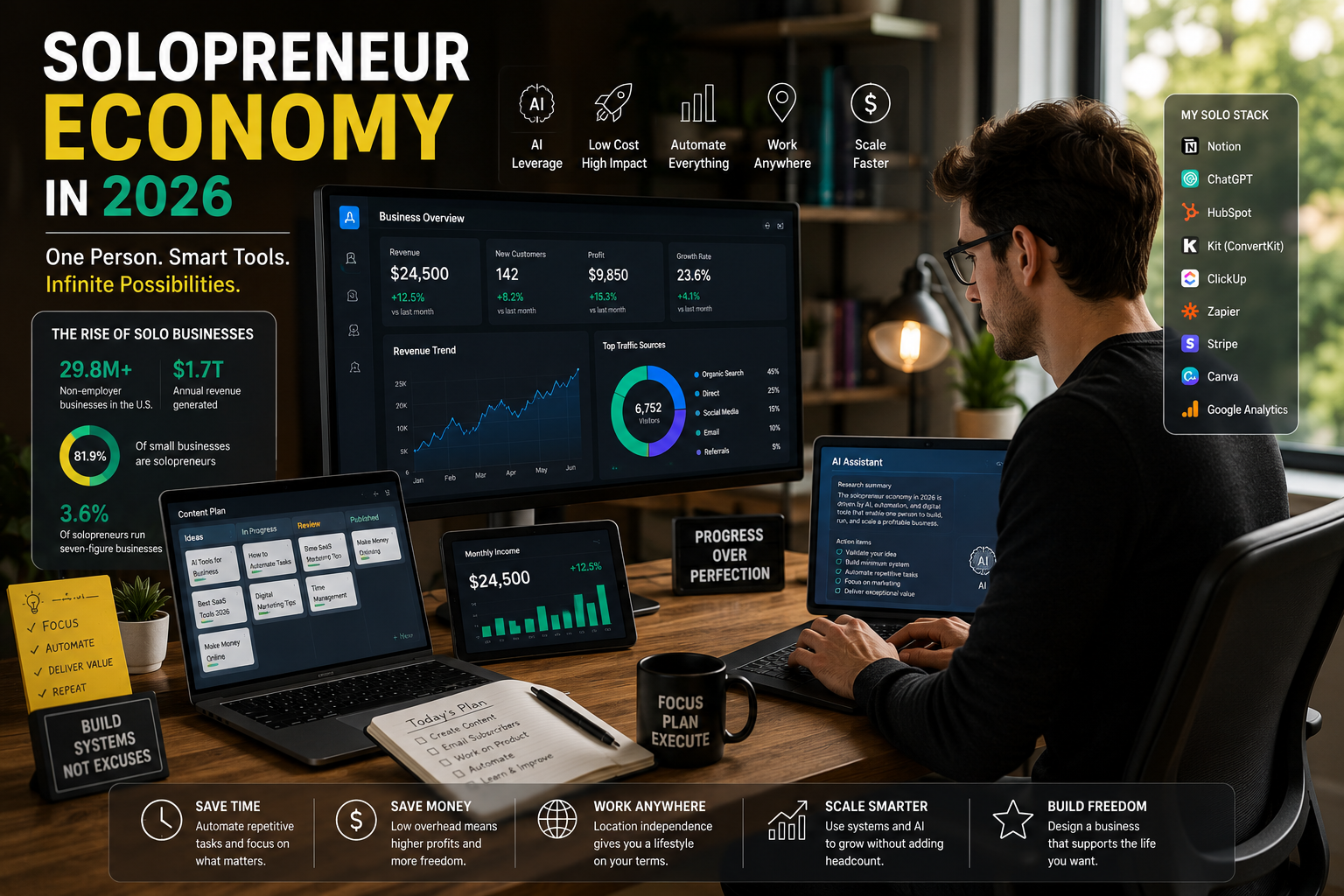
This isn’t a fringe trend confined to Twitter threads about “solo unicorns.” According to U.S. Census Bureau non-employer business data, roughly 29.8 million Americans now run businesses without a single hire, generating an estimated $1.7 trillion in annual revenue — about 6.8% of total U.S. economic output. These solopreneurs make up 81.9% of all small businesses in the country, and the share of new startups founded by a single person, rather than a co-founding team, has climbed from roughly 24% in 2019 to more than 36% by mid-2025, based on Carta’s venture data reported by Bloomberg.
The obvious question is why. What changed between the era when scaling a business meant hiring people, and today, when scaling increasingly means adding software instead of staff? Part of the answer is artificial intelligence. Part of it is a maturing generation of SaaS tools built specifically for solo operators. But the deeper answer — the one most coverage of this trend skips — is a shift in how founders think about leverage itself. This article walks through the data, the economics, the software stack, and the strategic mistakes to avoid, so you can decide whether the solopreneur economy in 2026 is a model worth building your own business around.
Table of Contents
- Why the Solopreneur Economy Stopped Being a Buzzword
- What Most Articles Get Wrong About Going Solo
- The Economics Behind the Shift
- The Psychology of Working Alone
- Traditional Company vs. Solopreneur: A Side-by-Side Look
- Automation ROI: What Founders Actually Get Back
- Real Examples: What a One-Person Business Looks Like Across Industries
- The Software Stack Powering Solo Operators
- Best SaaS Tools for Solopreneurs in 2026
- The PartnerStack Opportunity: Turning Your Tool Stack Into Revenue
- Growth, Revenue Models, and Business-Type Fit
- Where the Solopreneur Economy Goes From Here
- Should You Go Solo? A Decision Framework
- Common Mistakes Solopreneurs Make When Scaling With AI
- A 90-Day Action Plan for Going Solo
- Frequently Asked Questions
- Conclusion
Why the Solopreneur Economy Stopped Being a Buzzword
It’s worth separating hype from substance here, because “solopreneur” has been overused as a marketing term since roughly 2015. What’s different now is the data. Seventy-seven percent of solopreneurs report profitability within their first year of operation — a rate that would make most venture-backed startups jealous. And according to a 2026 OnDeck/Ocrolus small-business survey, 94% of solopreneurs expect their business to grow this year, with 71% already reporting stronger financial results in 2025 than the year before.
The growth isn’t only happening at the bottom of the income ladder, either. Census Bureau figures show that 117,060 one-person businesses and partnerships crossed the $1 million revenue mark in 2023, and solo business applications in professional services, information, finance, and education have climbed nearly 27% since early 2024. Roughly 3.6% of solopreneurs — close to a million people — now run seven-figure operations without a single employee, according to payroll platform Gusto’s founder survey.
The AI backdrop makes this easier to understand. Business AI adoption has gone from 55% of companies in 2023, to 78% in 2024, to roughly 91% in 2026, according to research aggregating McKinsey and Azumo workplace data. That kind of curve doesn’t just change how large companies operate — it changes what one determined person can realistically take on without a team.
Editorial Insight — Bashionline Research Desk
“The most misunderstood part of this shift is that people assume AI is generating the revenue. It isn’t. What AI actually removed was the justification for hiring — the content calendar, the first-line support tickets, the bookkeeping admin. Those tasks used to force a founder to add headcount. Now they don’t.”
What Most Articles Get Wrong About Going Solo
Nearly every guide to solopreneurship repeats the same three claims: pick a niche, buy some software, and enjoy the freedom. That advice isn’t false, but it skips the part that actually determines whether someone succeeds — and it’s worth naming directly, because it changes how you should approach the rest of this article.
- Misconception 1: More tools equal more leverage. In practice, the founders who struggle most are usually the ones running eight overlapping subscriptions, not the ones with too few. Leverage comes from three or four tools used well, not a stack collected out of FOMO.
- Misconception 2: Going solo means doing everything yourself. Most seven-figure solopreneurs still outsource — they just outsource tasks, not headcount. A freelance editor paid per project, a fractional bookkeeper billed hourly, an on-demand designer — none of that shows up as an “employee,” but it’s still delegation.
- Misconception 3: The hardest part is building the product. In reality, distribution — getting in front of the right audience — is what kills most solo businesses long before the product does. Founders who treat marketing as an afterthought rarely make it past year one, regardless of how good the underlying offer is.
This is the gap between reading about the solopreneur economy and actually operating inside it. The rest of this guide is built around closing that gap.
The Economics Behind the Shift
Every business, at its core, is a bundle of tasks. Historically, once that bundle grew past what one person could physically do in a day, the founder had two choices: work themselves into the ground, or hire. Hiring solved the capacity problem but introduced a new one — payroll, benefits, management overhead, office space, and the simple fact that people need to be trained, retained, and occasionally replaced.
AI tools changed the math on that trade-off. A solopreneur today can lean on generative AI for a first draft of almost anything — marketing copy, customer support replies, financial summaries, even working code — and then spend their limited hours reviewing and refining rather than producing from scratch. Gusto’s 2026 survey found that 64% of solopreneurs already use generative AI for marketing tasks, 37% for customer service, and 36% to support sales work.
The scale of the time savings is better documented than most people realize. Federal Reserve research on generative AI use in the workplace found an average time savings of 5.4% of work hours — about 2.2 hours a week for a standard 40-hour schedule, or roughly one reclaimed workday a month. Among frequent users, the gains are far larger: 27% of regular AI users save more than nine hours a week, and some power users report reclaiming 20 or more hours weekly by automating research, drafting, and administrative work. For a founder with no team to delegate to, that reclaimed time is the entire ballgame — it’s the difference between a business that requires 60-hour weeks and one that fits inside 35.
Zoom out further and the numbers get even larger. McKinsey estimates that generative AI alone could add between $2.6 trillion and $4.4 trillion to the global economy annually across the use cases it has studied, on top of the broader productivity gains from automation and analytics more generally. Solopreneurs aren’t the primary beneficiaries of that macro figure — large enterprises are — but they’re capturing a disproportionate share of the accessible piece of it, because a solo operator can adopt a new AI tool in an afternoon, while a 5,000-person company needs a procurement process, a pilot program, and a change-management plan.
There’s a second force at play that gets less attention than AI: the rise of “vibe coding,” the practice of describing a product in plain language and having an AI assistant generate the working software. With a large and growing share of developers now using AI coding tools in some capacity, the technical co-founder — once a hard requirement for any software business — has become optional for a large class of products. A solo operator can now describe an idea in the morning and have a functioning prototype by lunch.
The Psychology of Working Alone
None of this means solopreneurship is easy, and the surveys that show record optimism also show real strain. Roughly a third of solopreneurs report high stress, and a similar share describe feeling isolated without colleagues to share the load. This is worth taking seriously rather than treating as a footnote, because it’s the single biggest predictor of who quits — not lack of revenue.
There’s a decision-making pattern that shows up again and again among founders who make it past the first eighteen months: they build accountability structures deliberately, because nobody is doing it for them. That might mean a weekly call with another solo founder, a paid mastermind group, or simply a public commitment — publishing revenue numbers, posting weekly progress — that creates the same kind of social pressure a manager or co-founder would otherwise provide. Working alone doesn’t have to mean deciding alone, and the founders who separate those two things tend to last longer than the ones who don’t.
There’s also a subtler trap worth naming: solo founders tend to over-index on tasks they’re personally good at and under-invest in tasks they find unpleasant, regardless of which one actually drives revenue. A strong writer will happily spend four hours polishing an essay and then avoid sending ten cold outreach emails for weeks. Left unchecked, that bias quietly caps growth — the business becomes a reflection of the founder’s preferences rather than the market’s actual needs.
Traditional Company vs. Solopreneur: A Side-by-Side Look
The comparison below isn’t meant to suggest one model is universally better — a venture-backed team is still the right structure for many businesses. But for an enormous and growing category of online, service, and software businesses, the solo model now competes directly.
| Factor | Traditional Small Company (5–10 staff) | Solopreneur (1 founder + AI stack) |
|---|---|---|
| Monthly operating cost | $25,000 – $80,000+ | $300 – $2,000 |
| Time to launch a product | 3–9 months | 1–4 weeks |
| Decision-making speed | Meetings, approvals, alignment | Immediate |
| Scaling method | Hire more people | Add software / automate |
| Biggest risk | Payroll burden, management overhead | Founder burnout, no backup |
| Profit margin potential | Often 10–20% | Frequently 60–90% on digital products |
| Recovery from a bad month | Absorbed across team and cash reserves | Falls entirely on the founder |
| Institutional knowledge risk | Distributed across employees | Concentrated in one person |
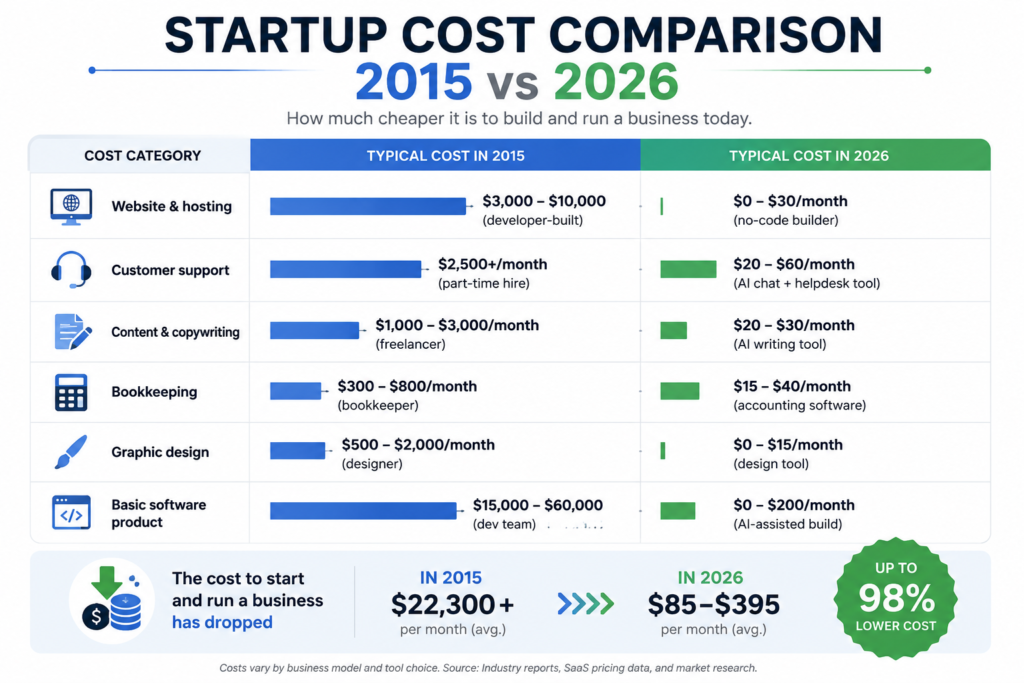
Startup Costs: 2015 vs. 2026
Automation ROI: What Founders Actually Get Back
“Automation saves time” is true but vague. What matters to a solo founder is which specific tasks are worth automating first, because not all time savings are equal — an hour saved on invoicing is not the same as an hour saved on sales follow-up.
| Task Automated | Typical Manual Time (Weekly) | Typical Time After Automation | Where the Saved Time Should Go |
|---|---|---|---|
| Email/newsletter sending | 3–5 hours | 20–30 minutes | Content creation or sales calls |
| Invoicing & payment follow-up | 2–4 hours | 10–15 minutes | Client relationship work |
| Basic customer support replies | 5–10 hours | 1–2 hours (review only) | Product improvement |
| Social media scheduling | 3–4 hours | 30–45 minutes | Original content strategy |
| Bookkeeping & categorization | 2–3 hours | 15–20 minutes | Financial planning, not just recording |
Real Examples: What a One-Person Business Looks Like Across Industries
Abstract statistics only tell half the story. It helps to look at how solo operators across different industries and experience levels are actually structuring their businesses.
The Niche Newsletter Operator
A former mid-level marketing manager builds a paid newsletter covering a narrow industry — say, compliance software for credit unions. She uses an AI writing assistant to draft outlines and first drafts, an email marketing platform to manage subscribers and automate onboarding sequences, and a scheduling tool to book sponsor calls. Within eighteen months, the newsletter clears six figures in annual revenue, split between subscriptions and sponsorships, with zero employees.
The Solo SaaS Founder
A developer with a day job notices a repetitive, painful task in his own industry — reconciling spreadsheets across departments — and builds a lightweight tool to solve it, using AI-assisted coding to compress a project that once needed a small engineering team into a few weekends. He launches on a no-code payment platform, handles support himself with an AI-assisted helpdesk, and reinvests early revenue into ads rather than hires.
The Service-to-Product Consultant
A freelance brand strategist who once traded hours for client fees eventually productizes her process into a self-serve course and a template library, sold through a simple website builder. The shift — from billing hours to selling a repeatable product — is the single most common pattern among solopreneurs who eventually cross the seven-figure mark, because it decouples revenue from the number of hours the founder personally works.
The First-Time Founder With No Business Background
A warehouse supervisor with no marketing or coding experience starts a small e-commerce store selling a niche accessory line, using an AI product-description tool, a drag-and-drop storefront, and a fulfillment partner to avoid holding inventory herself. The business stays modest — around $4,000 a month in profit — but it replaces her previous income within a year, run entirely around her existing work schedule. This example matters precisely because it isn’t a breakout success story; it’s the realistic, more common outcome, and still a meaningful one.
The Creative Industry Escapee
A laid-off video editor builds a productized service offering fast-turnaround short-form video edits for small businesses, using an AI video tool to handle rough cuts and captioning before doing the final creative pass himself. Because the AI layer compresses the most time-consuming part of the job, he can serve triple the client volume he handled at his old agency job, working fewer hours.
Image 2 — Suggested image: Split-screen graphic showing a traditional office team on one side and a single entrepreneur with a laptop and AI icons on the other. ALT text: one-person business vs traditional company
The Software Stack Powering Solo Operators
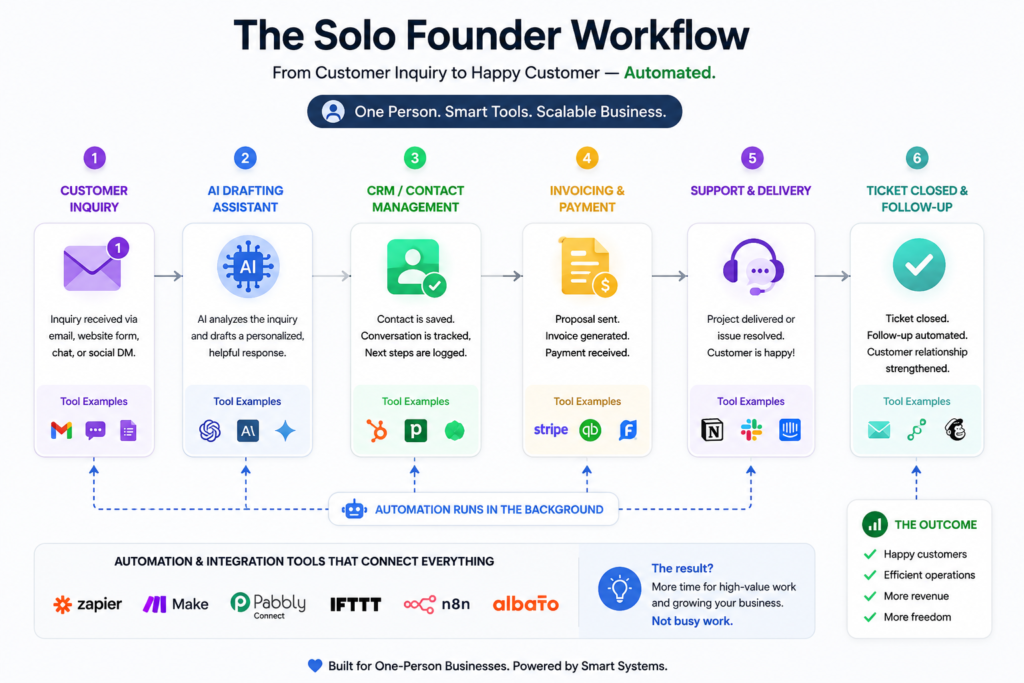
Every solopreneur eventually assembles what amounts to a virtual team, made entirely of software. The categories rarely change — marketing, operations, finance, and support — but the tools inside them have matured enormously, and the number of categories worth having an opinion on has grown. The section below breaks down the categories that matter most, along with genuine, widely used platforms in each, why each one earns its place, and who actually needs it.
AI Automation for Small Businesses in 2026
Best SaaS Tools for Solopreneurs in 2026
AI Assistants
Problem it solves: acting as a general-purpose thinking partner for drafting, research, planning, and decision support across the entire business, not just one function. Ideal user: literally every solopreneur, regardless of industry.
Business impact: founders who treat an AI assistant as a first-draft generator across writing, code, and strategy tend to report the highest overall time savings of any single tool category, because it touches every part of the day rather than one department.
CRM
Problem it solves: keeping track of leads, client conversations, and follow-ups without a shared team inbox. Ideal user: consultants, agencies-of-one, and service providers managing multiple client relationships at once.
HubSpot’s CRM is the most common starting point because its free tier is genuinely functional, not a stripped-down trial, and it connects cleanly to the rest of its marketing suite as a business grows. The business impact shows up mainly in fewer dropped follow-ups — a lead that goes three days without a reply is a lead that’s usually gone for good.
Email Marketing
Problem it solves: turning one-time visitors into repeat customers through automated sequences. Ideal user: creators, newsletter writers, and course sellers who need to nurture an audience without manually sending every message.
Kit (formerly ConvertKit) remains a favorite among solo creators because its automation builder is genuinely usable without a marketing background, and its pricing scales gently as a list grows.
Project & Task Management
Problem it solves: keeping a business organized when there’s no team to divide labor across. Ideal user: anyone juggling multiple clients, product launches, or content pipelines at once.
Notion works well as an all-in-one workspace for documentation and light project tracking. ClickUp and Monday.com go further for solopreneurs who want structured pipelines, recurring task automation, and client-facing boards. The real business impact is fewer dropped balls, not faster task completion — the tool’s job is memory, not speed.
Automation
Problem it solves: connecting tools that don’t natively talk to each other — a new sale should trigger an email, a spreadsheet update, and a notification without the founder lifting a finger.
Zapier remains the default choice for no-code automation between hundreds of apps, and it’s often the single tool that saves a solopreneur the most hours per week, precisely because it removes the manual glue-work between every other tool on this list.
Analytics
Problem it solves: knowing which marketing channel, product, or piece of content is actually driving revenue, rather than guessing based on gut feel.
Even a lightweight analytics dashboard pays for itself quickly for a solopreneur, because it exposes the handful of channels doing most of the work — and the many that quietly aren’t, freeing up time currently spent on low-return activity.
Accounting & Finance
Problem it solves: tax compliance and cash-flow visibility without a bookkeeper on retainer. Ideal user: any solopreneur earning consistent revenue who needs clean books at tax time.
Cloud accounting platforms built for freelancers and small operators — the kind that auto-categorize transactions and generate quarterly tax estimates — have become table stakes rather than a luxury. Pairing accounting software with a dedicated business bank account is one of the highest-leverage, lowest-effort decisions a new solopreneur can make.
Payments
Problem it solves: getting paid quickly, securely, and in a way that looks professional to clients or customers, without building custom checkout infrastructure.
Payment infrastructure providers such as Stripe have made it possible for a solopreneur to accept cards, manage subscriptions, and handle international payments with a few lines of pre-built code or a no-code integration — infrastructure that used to require a dedicated finance and engineering team.
Website & Storefront Builders
Problem it solves: launching a professional-looking site or store without hiring a developer. Ideal user: anyone selling a product, service, or digital download directly to consumers.
Webflow gives design-conscious solopreneurs more visual control than most no-code builders, while Shopify remains the standard for anyone selling physical or digital products at volume.
Forms & Data Collection
Problem it solves: collecting client intake information, applications, or survey data without manual back-and-forth emails.
A simple, well-designed form tool does double duty as both a data-collection and a light qualification tool — routing better-fit leads differently from poor-fit ones before a founder ever spends time on a call.
AI Writing & Editing
Problem it solves: producing consistent, polished content — blog posts, emails, product descriptions — without hiring a writer or editor.
Grammarly has evolved well beyond grammar-checking into a full writing assistant, and it pairs naturally with any AI drafting tool as a final polish layer before publishing.
SEO & Content Research
Problem it solves: understanding what to write about and whether it will actually rank, rather than guessing.
Semrush remains one of the most complete platforms for keyword research, competitor analysis, and technical SEO audits — arguably overkill for a hobby blog, but a reasonable investment for a content business.
Design
Problem it solves: producing branded graphics, social posts, and presentations without a designer on payroll.
Canva’s template library and brand kit features let a non-designer produce consistent, professional visuals in minutes rather than hours.
Video Editing
Problem it solves: producing short-form and long-form video content at a pace one person can sustain, without a dedicated editor.
AI-assisted video tools that handle rough cuts, captioning, and basic color correction have compressed a task that used to take hours per minute of finished footage down to a fraction of that, particularly for repeatable formats like talking-head or tutorial content.
Customer Support
Problem it solves: answering common customer questions instantly, at any hour, without the founder being permanently on call.
AI-assisted helpdesk tools that can draft or fully automate replies to routine tickets have become one of the highest-leverage additions to a solo tech stack, precisely because support volume tends to grow with revenue.
Scheduling
Problem it solves: eliminating the back-and-forth of booking calls, consultations, or client sessions.
A simple booking-link tool synced to a calendar removes an entire category of email exchanges — small on its own, but it adds up across dozens of client relationships.
Cloud Storage
Problem it solves: keeping contracts, brand assets, and client files organized and accessible from anywhere, with automatic backup.
Cloud storage stops being optional the moment a solopreneur has even one client-facing deliverable that would be painful to lose — which, in practice, is almost immediately.
Password Management
Problem it solves: securing the growing number of logins a solo founder accumulates across every tool on this list, without reusing weak passwords.
This is the single most skipped category on this entire list, and arguably the one with the worst downside if ignored — a compromised email or payment account can undo months of work in an afternoon.
Knowledge Management
Problem it solves: keeping standard operating procedures, client history, and institutional knowledge somewhere other than the founder’s memory.
A basic internal wiki or notes system matters more for solopreneurs than for teams, ironically, because there’s no colleague to catch what the founder forgets.
Developer Tools
Problem it solves: building, hosting, and maintaining software products without a dedicated engineering hire.
AI-assisted coding assistants, paired with modern low-maintenance hosting platforms, have made it realistic for a non-technical or lightly technical founder to ship and maintain a working product.
Research Tools
Problem it solves: staying current on a niche, competitor moves, and industry data without spending hours manually searching.
AI-powered research and search tools now let a solo founder do in twenty minutes what used to require a research assistant or a full afternoon of manual searching — a meaningful edge for anyone publishing content or making fast-moving strategic decisions.
General Productivity
Problem it solves: protecting the founder’s own attention and time, which is the actual scarce resource in a one-person business.
Time-blocking and focus tools matter more here than in a team setting, because there’s no manager enforcing boundaries — the founder has to build that discipline into the system itself.
Expert Insight
“The founders who burn out aren’t the ones using too much software — they’re the ones using too little. A well-chosen stack of six or seven tools, properly connected, replaces what used to be a five-person team. Past that, more tools usually mean more admin, not more leverage.”
Tool Comparison: What Each Platform Is Actually Best At
| Category | Tool | Best For |
|---|---|---|
| Email Marketing | Kit (ConvertKit) | Creators & newsletter writers |
| CRM | HubSpot | Consultants & client-based businesses |
| Project Management | ClickUp / Notion | Multi-project solopreneurs |
| Automation | Zapier | Connecting disconnected tools |
| Website Builder | Webflow / Shopify | Design-first sites / e-commerce |
| AI Writing | Grammarly | Polishing AI-drafted content |
| SEO | Semrush | Content-driven businesses |
| Design | Canva | Non-designers needing fast visuals |
| Payments | Stripe | Subscriptions & online checkout |
Best Tool Stack by Business Type
| Business Type | Core Priority | Recommended Starting Stack |
|---|---|---|
| Content / newsletter business | Audience growth & retention | Email marketing + AI writing + SEO tool |
| Consulting / service business | Client relationships & scheduling | CRM + scheduling tool + invoicing/accounting |
| Micro-SaaS / software product | Build speed & reliability | AI coding assistant + hosting + payments |
| E-commerce / physical product | Fulfillment & storefront | Website builder + payments + design tool |
| Coaching / course business | Delivery & community | Website builder + email marketing + scheduling |
The PartnerStack Opportunity: Turning Your Tool Stack Into Revenue
Here’s a detail most beginner guides skip: the same SaaS tools solopreneurs rely on to run their businesses often pay them to recommend those tools to others. Many software companies — including a number of the platforms mentioned above — run affiliate or partner programs through networks like PartnerStack, paying a recurring commission for every paying customer a creator refers, rather than a one-time payout.
For a solopreneur already writing about productivity, marketing, or business software, this creates a natural second revenue line, and it compounds in a way most other income sources don’t — a referral made this month can keep paying out monthly for years, as long as the referred customer stays subscribed. The key is sequencing it correctly: recommend a tool because it’s genuinely useful, disclose the relationship honestly, and only promote software you’ve actually used. Readers can tell the difference between a genuine recommendation and a commission grab, and search engines increasingly reward the former through stronger engagement signals.
It’s worth checking each platform’s current partner program directly before publishing, since affiliate terms and PartnerStack participation change over time, and not every tool mentioned in this article is necessarily active on that specific network at any given moment. Treat commission potential as a bonus layer on top of a genuinely helpful article — not the reason the article exists. The strongest affiliate content, consistently, reads like it would have been written even without a commission attached.
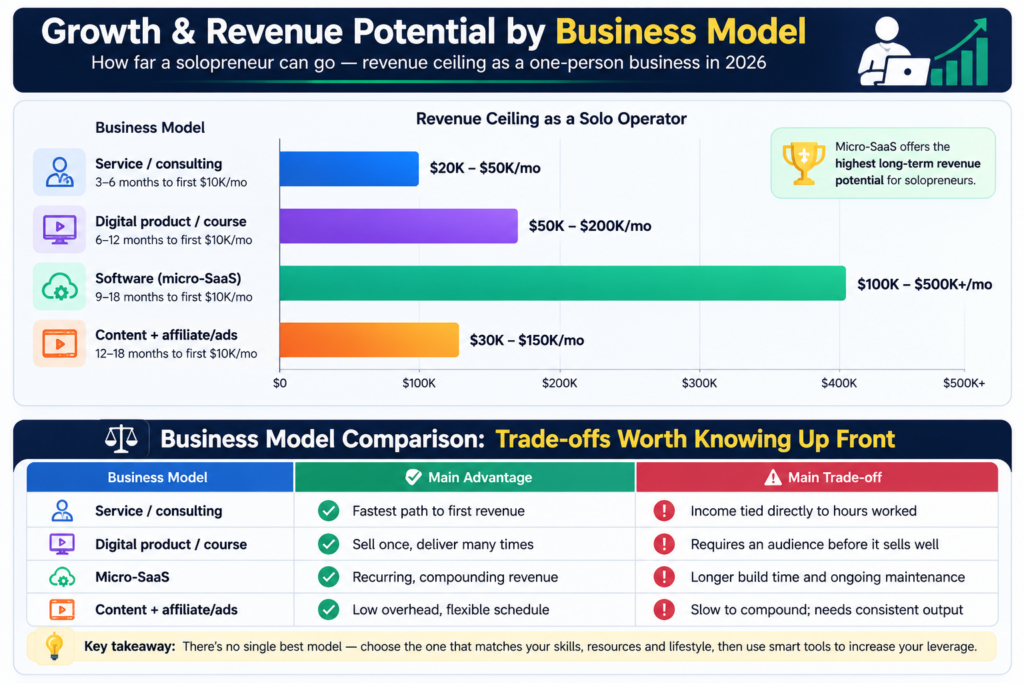
Growth, Revenue Models, and Business-Type Fit
| Business Model | Typical Time to First $10K/Month | Revenue Ceiling as a Solo Operator |
|---|---|---|
| Service / consulting | 3–6 months | Capped by hours available |
| Digital product / course | 6–12 months | High — scales without more hours |
| Software (micro-SaaS) | 9–18 months | Very high — recurring revenue |
| Content + affiliate/ads | 12–18 months | Moderate to high, compounds over time |
Business Model Comparison: Trade-offs Worth Knowing Up Front
Where the Solopreneur Economy Goes From Here
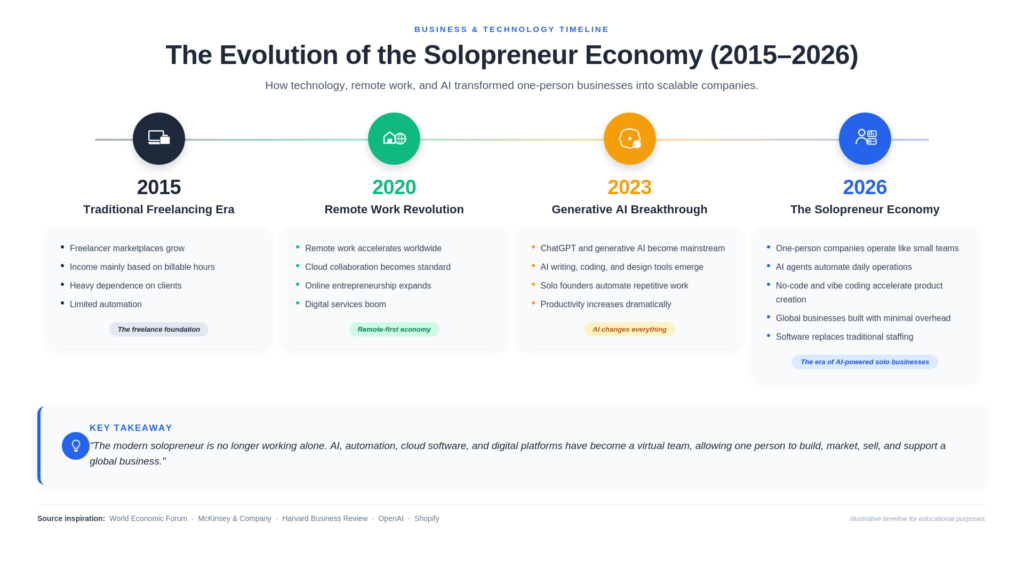
A few patterns look durable heading into the next few years. First, AI adoption among solo founders will likely keep climbing, simply because the tools keep getting more capable and cheaper, and agentic AI systems — tools that can plan and execute multi-step tasks rather than just generate text — are moving from experimentation toward mainstream use across businesses of every size, including solo ones.
Second, expect regulatory attention: as tens of millions of people build their entire livelihood around non-employer businesses, questions around benefits, retirement savings, and worker classification will get louder — organizations like the World Economic Forum and Harvard Business Review have already flagged the broader “future of work” implications of a labor market shifting toward independent, tech-enabled operators.
Third, community is becoming the missing piece of the solo model. Because isolation is one of the most consistently reported downsides of running a business alone, expect continued growth in paid communities, mastermind groups, and cohort-based programs built specifically for solopreneurs — a direct response to the loneliness data rather than a fad.
Finally, geography keeps flattening. Rural solopreneur growth is currently running well ahead of the pace seen in major urban centers, according to recent labor-market analysis, reinforcing that this is a location-independent shift rather than one confined to major startup hubs.
Digital Marketing Strategies 2026
Should You Go Solo? A Decision Framework
Not every business — and not every founder — is a good fit for the solo model. Before committing, it’s worth running through a short set of honest questions rather than assuming enthusiasm alone will carry you through the first year.
- Does your product or service require physical infrastructure, licensed staff, or regulatory approval that can’t be handled by one person? If yes, a pure solo model is unlikely to work long-term.
- Can you tolerate being the single point of failure for client delivery, at least for the first year? If the honest answer is no, plan for at least one contractor from day one.
- Are you building something that needs to grow fast to defend a market position, or something that can grow steadily over years? Speed-sensitive, capital-intensive categories usually favor a funded team; steady, niche categories favor a solo build.
- Do you already have — or are you willing to build — a support system outside the business itself? Given how consistently isolation shows up as a reason solopreneurs quit, this isn’t optional.
Common Mistakes Solopreneurs Make When Scaling With AI
- Automating before validating — building a full AI-powered workflow around an offer nobody has paid for yet.
- Over-subscribing to overlapping tools instead of choosing one platform per core function.
- Treating AI output as finished work rather than a first draft that still needs a human review pass.
- Ignoring the loneliness factor — skipping peer communities that offset the isolation of working alone.
- Selling time instead of building a product, which caps revenue at the number of hours in a week.
- Delaying basic financial systems (accounting software, separate business banking) until tax season forces the issue.
- Skipping password management and basic security hygiene, which turns a single compromised login into a business-ending event.
- Avoiding distribution work in favor of product work, even though distribution is the more common point of failure.
A 90-Day Action Plan for Going Solo
- Weeks 1–2: Pick one narrow problem for one specific audience — not a broad idea. Validate demand with a waitlist, pre-sale, or a handful of paid pilot clients before building anything.
- Weeks 3–4: Build your minimum tool stack — one CRM or contact system, one project tracker, one accounting tool, and one AI writing or coding assistant. Resist adding more than that early on.
- Weeks 5–8: Launch the smallest usable version of your offer. Use AI tools to compress production time on content, code, or design, but personally review everything before it goes out.
- Weeks 9–10: Automate your first repetitive task with a no-code automation tool — usually onboarding emails, invoice reminders, or support replies.
- Weeks 11–12: Review your numbers. Identify which single channel brought in the most revenue and double down on it rather than spreading effort across five untested channels.
- Ongoing: Join at least one community of other solo operators. The data is consistent — isolation, not workload, is what causes most solopreneurs to quit.
Frequently Asked Questions
Is the solopreneur economy actually growing, or is this just a media narrative?
It’s growing by measurable standards. U.S. Census Bureau data puts non-employer businesses at 29.8 million, generating $1.7 trillion in revenue, and the share of solo-founded startups on platforms like Carta has risen from roughly 24% in 2019 to more than 36% by 2025.
Do I need to know how to code to build a solo software business in 2026?
Not necessarily. AI-assisted development, often called “vibe coding,” lets non-technical founders describe a product in plain language and generate working software, though a basic understanding of how the pieces fit together still helps enormously when something breaks.
How much does it realistically cost to start a solo business today?
Many solopreneurs launch on a few hundred dollars a month in software subscriptions rather than the tens of thousands once needed for staff, office space, and custom development — though costs still scale with the complexity of the business.
What’s the biggest risk of running a business alone?
Financially, it’s the lack of a backup if the founder is sick or burned out. Emotionally, survey data consistently points to isolation — solopreneurs report meaningfully higher rates of loneliness and stress than business owners who have at least one employee.
Can a solopreneur really compete with a funded startup?
In categories where the product doesn’t require heavy capital or physical infrastructure — software, content, digital products, consulting — yes. Solo-founded companies now represent a growing share of venture-backed startups, and many profitable online businesses never raise outside funding at all.
How many SaaS tools does a solopreneur actually need to get started?
Fewer than most people assume. A workable starting stack is usually four to six tools — one for communication with clients or an audience, one for organizing work, one for finances, and one AI assistant that supports writing, coding, or research. Additional categories can be added as specific pain points appear, rather than all at once.
Should a solopreneur incorporate as an LLC or stay a sole proprietor?
This depends heavily on jurisdiction, liability exposure, and revenue level, and it’s a legal and tax question rather than a software one — a licensed accountant or attorney is better positioned to advise on the specifics than a general business guide.
What’s the realistic timeline before a solopreneur can replace a full-time salary?
It varies enormously by business model, but service-based businesses tend to reach meaningful income fastest, often within three to six months, while product and software businesses generally take longer to compound — often nine months to two years — but carry a higher long-term ceiling once they do.
Is affiliate income through networks like PartnerStack a reliable revenue stream?
It can be a meaningful secondary stream for content-focused solopreneurs, but it’s rarely a sole foundation. It works best layered on top of an audience or business that already exists for other reasons, rather than as the sole reason for creating content.
Conclusion
The solopreneur economy in 2026 isn’t a workaround for people who couldn’t build a “real” company. It’s a legitimate operating model, backed by tens of millions of businesses and trillions of dollars in revenue, made possible by a genuine shift in what one person can accomplish with the right software behind them. The founders winning at this aren’t the ones chasing every new AI tool that launches — they’re the ones who picked a narrow problem, built a lean stack, protected their own time as fiercely as their margins, and built in the accountability that a team would otherwise have provided.
Whether you’re weighing a full leap into solo business or simply looking to run your existing side project more efficiently, the tools and frameworks covered here are a reasonable starting point rather than a finish line. The stack will keep changing. The underlying principle — fewer people, better systems, more leverage per hour, and real accountability built in deliberately — looks like it’s here to stay.
Ready to Build Your Own One-Person Business?
Start small: pick one problem, one audience, and a lean tool stack of four to six platforms — you can always add more once the revenue justifies it. Run the decision framework above honestly before you commit. Then build the systems, not just the product: a place to track leads, a way to get paid, and one AI assistant doing the heavy lifting on your first drafts.
Explore the software categories above, test a couple of free tiers this week, and read the related guides on automation and marketing linked throughout this piece for the next layer of detail. Come back to Bashionline as you grow — the solopreneur economy moves fast, and the tools and tactics that matter most will keep evolving alongside it.
Recommended External References
- Google Search Central → https://developers.google.com/search
- HubSpot Research → https://www.hubspot.com/resources
- Stripe → https://stripe.com/resources
- U.S. Census Bureau Non-Employer Statistics → https://www.census.gov/programs-surveys/nonemployer-statistics.html
- McKinsey State of AI → https://www.mckinsey.com/capabilities/quantumblack/our-insights/the-state-of-ai
- Federal Reserve → https://www.federalreserve.gov/
- World Economic Forum → https://www.weforum.org/
- OECD → https://www.oecd.org/
- Harvard Business Review → https://hbr.org/
- Statista → https://www.statista.com/
- Gartner → https://www.gartner.com/