

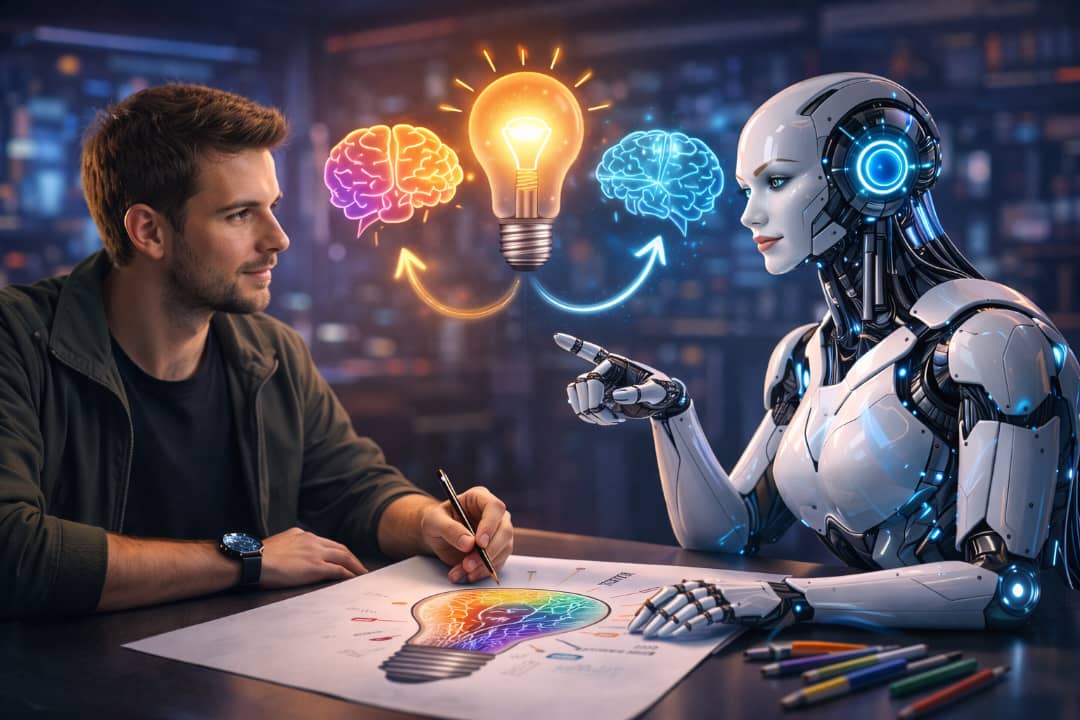
The design industry isn’t being replaced by AI in 2026 — it’s being restructured by it. What used to be manual, time-consuming production work is increasingly automated, which has shifted what businesses actually pay designers for: less pure execution, more creative direction and strategic judgment that AI still can’t replicate.
AI Tools Have Moved Into the Core Workflow
AI is no longer a separate experiment sitting outside a designer’s toolkit — it’s built into the software itself. Tools like Adobe Firefly, Canva, and Figma now offer automated layout generation, text-to-image creation, smart color suggestions, and instant resizing across platforms. The practical effect is that designers spend less time on repetitive production tasks — resizing, background removal, basic color correction — and more time on the parts of a project that require actual judgment.
What AI Still Can’t Do
AI can generate a logo, a social post, or a UI mockup competently, but brand strategy, emotional storytelling, and genuine creative direction remain distinctly human skills. The clearest way to think about the current split: AI increasingly handles production, while people handle meaning and direction. Designers who position themselves purely as production workers — executing a brief exactly as given — are the most exposed to this shift; designers who position themselves as strategic creative partners are not.
Personalization Has Become a Real Design Discipline
AI-assisted personalization — dynamic ads, adaptive landing pages, and email visuals that shift based on user behavior — has moved from a large-enterprise capability to something accessible at much smaller scale. This has turned personalization into a genuine design specialty rather than a one-off feature, and designers who understand how to build for it are increasingly valuable to marketing-driven businesses.
The Skills Worth Building
- Real fluency with AI design tools — not just using them, but knowing when their output is good enough and when it needs a human hand.
- UX/UI fundamentals, which remain the backbone of any interface work regardless of how much of it gets AI-assisted.
- Prompt writing for creative tools — getting useful output from AI systems is a distinct, learnable skill, not an automatic byproduct of using them.
- Brand and storytelling judgment, which is exactly the part of the job that’s becoming more valuable as production gets automated.
Ethical Questions the Industry Is Still Working Through
AI-generated design raises real, unresolved questions: who owns AI-assisted creative work, whether heavy reliance on automation erodes originality across an industry that increasingly draws from the same tools, and what happens to entry-level design roles that traditionally built skill through the exact repetitive work AI now automates. None of these have a clean answer yet, and treating them as settled would be dishonest. The industry is moving toward AI as a support tool rather than a replacement, but how that plays out for junior designers specifically is still an open question.
New Ways Designers Are Earning
Client work is no longer the only path to design income. Selling digital templates, offering subscription-based design services, and building a design-adjacent audience that supports affiliate income for the SaaS tools designers already use daily are all increasingly viable alongside — or instead of — traditional freelance client work. Combining a few of these creates income that isn’t entirely dependent on winning the next client.
The Honest Outlook
Designers who treat AI as a threat to avoid tend to fall behind designers who treat it as a tool to direct. The role is shifting from pure execution toward creative direction, strategy, and judgment — which, if anything, raises the ceiling for designers willing to develop those skills, while genuinely reducing demand for purely production-focused work. If you’re weighing design against other tech-adjacent career paths, our guide on starting a tech career without a degree covers how to build a portfolio-driven path into any of them.
Author
Written by Alibashi Abdirahman Olad, founder and publisher of BashiOnline.
Disclaimer
This content is for educational purposes only. Career and income outcomes vary based on individual skill, market conditions, and effort.
[…] The Future of the Design Industry 2026: AI and Graphic Design Revolution […]